
If you think all tattoos are just ink on skin, think again!
Lily tattoos, with their rich symbolism and breathtaking beauty, represent much more than meets the eye.
In this blog post, we’ll dive into the world of lily tattoos, discussing their meanings, trending styles, and how to choose the perfect design to tell your unique story.
✅ The 33 Lily Tattoo Ideas
1. Petite Pink Lily Forearm Tattoo

A single pink lily makes a strong focal point without requiring a large tattoo. The detailed petals and slender stem give the piece a graceful vertical shape that sits naturally along the forearm. Keeping the leaves muted allows the pink bloom to stand out, making this a useful reference for anyone considering color in a relatively small floral tattoo.
2. Minimal Lily Stem on the Inner Forearm
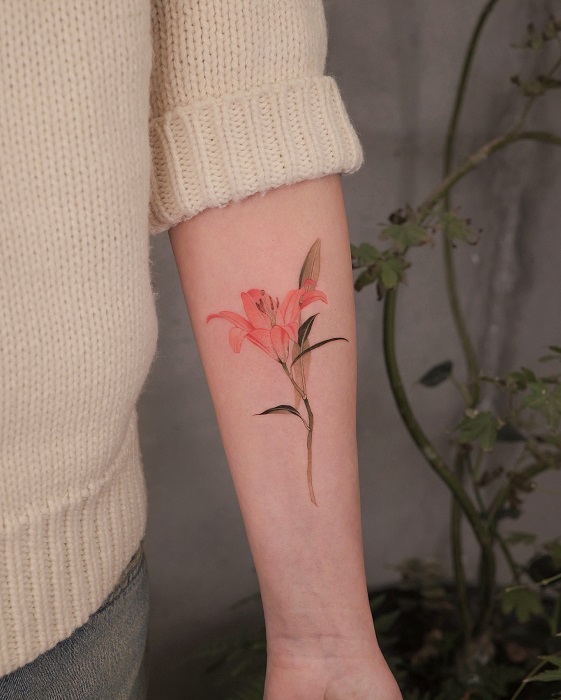
With its long stem, narrow leaves, and softly colored petals, this lily tattoo takes advantage of the inner forearm’s naturally elongated space. The restrained composition keeps the flower recognizable without adding lots of surrounding detail. It is an appealing direction for someone who likes botanical tattoos that feel light, uncluttered, and easy to appreciate at a glance.
3. Fine-Line Lily Pair on the Upper Arm

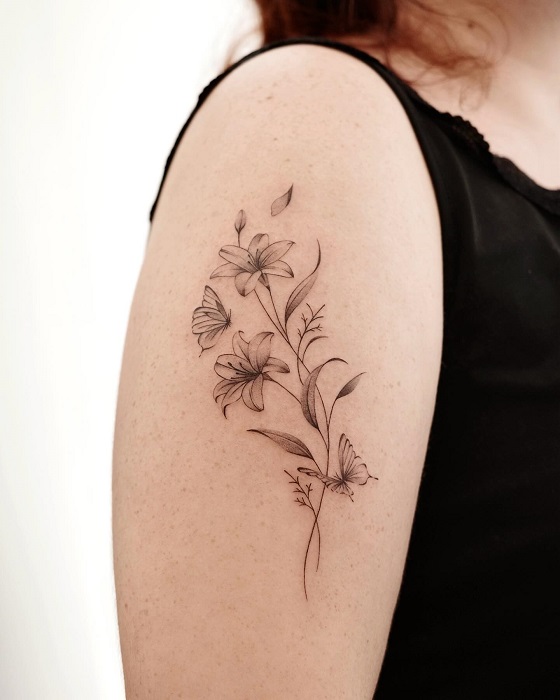
Fine outlines give these two lilies an airy, sketch-like quality, while the overlapping stems prevent the arrangement from feeling overly symmetrical. The upper-arm placement also provides enough room for the petals to remain clearly defined at this modest scale. Using little to no color puts more attention on shape and linework, creating a quieter interpretation of a lily tattoo.
4. Soft Botanical Lily Tattoo

Subdued pinks, earthy greens, and delicate shading make this lily feel closer to a botanical illustration than a boldly outlined tattoo. Its slim upright composition fits neatly on the arm without occupying much width. This softer treatment shows how color does not have to be highly saturated to make an impact; muted tones can create an understated, almost vintage-looking floral piece.
5. Flowing Pink Lilies Across the Shoulder

Rather than following a straight stem, these pink lilies are connected by sweeping lines that travel from the shoulder toward the upper arm. That movement makes the tattoo interact with the contours of the body and gives a relatively open composition more presence. It is a useful example of how lilies can form part of a larger, more expressive floral arrangement.
6. Colorful Lily and Wildflower Forearm Piece

Lilies take center stage here, but smaller blossoms, tiny butterflies, and scattered botanical details turn the tattoo into a miniature garden. Pink, purple, blue, and green create variety while the loose vertical arrangement keeps everything connected. For a more elaborate lily tattoo, combining one dominant flower with smaller supporting elements can add richness without making every part compete equally for attention.
7. Black Fine-Line Lilies With Butterflies

Black linework gives this upper-arm piece a crisp illustrative character, with lilies, foliage, and butterflies arranged into one cohesive botanical scene. The varied directions of the leaves and petals keep the composition lively rather than rigid. Butterflies are commonly associated with transformation and change, so pairing them with flowers can also introduce another potential layer of symbolism without relying on color.
8. Watercolor-Style Pink Lily on the Lower Leg
Concentrated pink and magenta tones make the open lily the visual anchor of this lower-leg tattoo, while the buds above extend the composition vertically. Soft transitions in the petals contrast with darker outlines and greenery, creating a watercolor-inspired effect. The placement demonstrates how a single flowering stem can fill a narrow section of the leg without needing a wide or complicated arrangement.
9. Outline Lily Tattoo With a Date

Two large outlined lilies create the main structure of this upper-arm tattoo, while the clearly visible “1972” adds a personalized element beneath the flowers. The restrained black linework keeps the date from competing with the blooms and makes the overall piece feel cohesive. Incorporating a meaningful year is one way to turn a decorative floral idea into something more individually significant.
10. Black Girly Lily Tattoo on Upper Shoulder

Black ink gives this lily tattoo a refined, feminine look while allowing the flower’s petal shapes and fine details to remain the focus. The upper shoulder offers enough space for the bloom to open naturally and can make the design easy to show or conceal depending on clothing. Delicate linework can keep a dark floral tattoo feeling graceful rather than visually heavy.
11. Three-Flower Lily Tattoo With Tiny Lettering
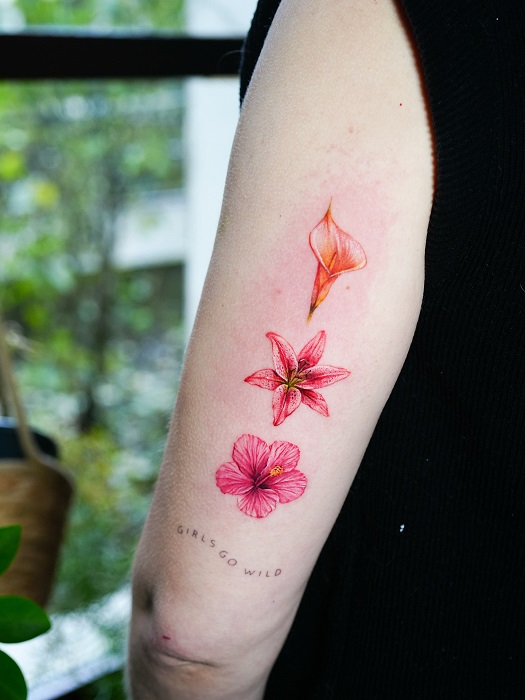
Three different blooms are stacked vertically along the upper arm, with a star-shaped lily occupying the center of the composition. The shift from orange to deep pink gives each flower its own identity, while the small “GIRLS GO WILD” lettering adds an unexpected graphic detail. This approach shows how lilies can work within a mixed-flower tattoo rather than always appearing as a standalone botanical.
12. Purple Lily Collarbone Tattoo

Rich purple and mauve tones give this floral piece a moodier character than the softer pink lily tattoos in the collection. Its branch-like arrangement stretches horizontally across the collarbone and shoulder, following the body rather than sitting in a compact cluster. Small botanical accents and a delicate winged detail add visual interest around the larger flowers without overwhelming them.
13. Tiny Black-and-Grey Lily Ankle Tattoo

Small scale does not have to mean minimal detail. This ankle lily uses soft black-and-grey shading inside the petals and leaves, contrasted by exceptionally thin stems that taper toward the foot. The result feels more like a miniature pencil drawing than a heavy floral tattoo, offering useful inspiration for anyone drawn to discreet placement and finely rendered botanical artwork.
14. Crowned Pink Lily With Script

Placing an ornate crown above a pale pink lily immediately changes the character of this floral motif, giving it a regal, decorative edge. Green leaves provide stronger contrast, while a narrow line of script visually continues the stem downward. For a personalized lily tattoo, this demonstrates how symbolic objects and lettering can be integrated into the flower’s natural vertical structure.
15. Geometric Lilies Down the Upper Back
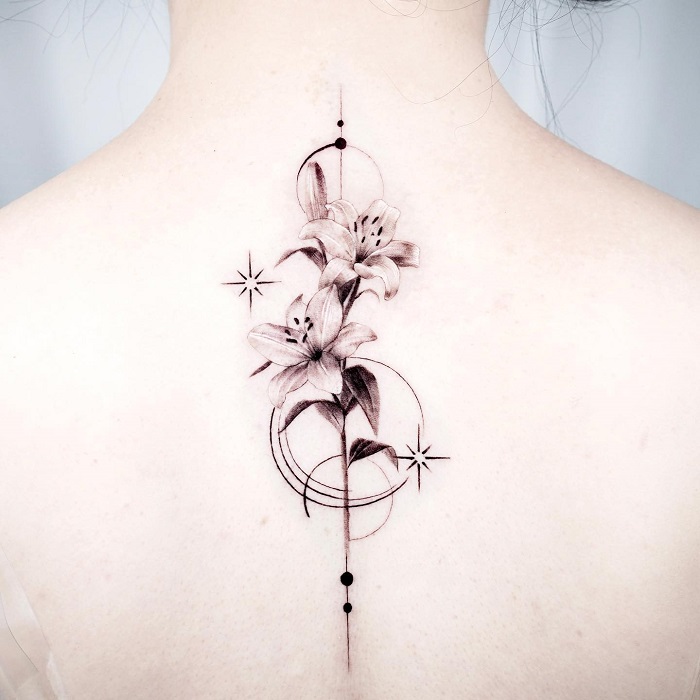
Centered along the spine, this composition combines the organic shapes of lilies with circles, dots, straight lines, and star-like accents. The contrast between precise geometry and softly shaded petals gives the tattoo a distinctive ornamental quality. Because the design is strongly symmetrical and vertical, the upper back provides an especially effective canvas, allowing the composition to follow the body’s centerline naturally.
16. Soft Pink Lily Bouquet

Two open lilies and a pair of closed buds capture several stages of the flower within one compact forearm arrangement. Instead of relying on dark outlines, the artist uses gentle pink shading, speckled petal details, and slim green stems to define the bouquet. The buds are particularly useful compositionally, adding height while keeping the tattoo narrower than a cluster of fully opened blooms.
17. Lily, Sunflower, and Butterfly Linework Tattoo
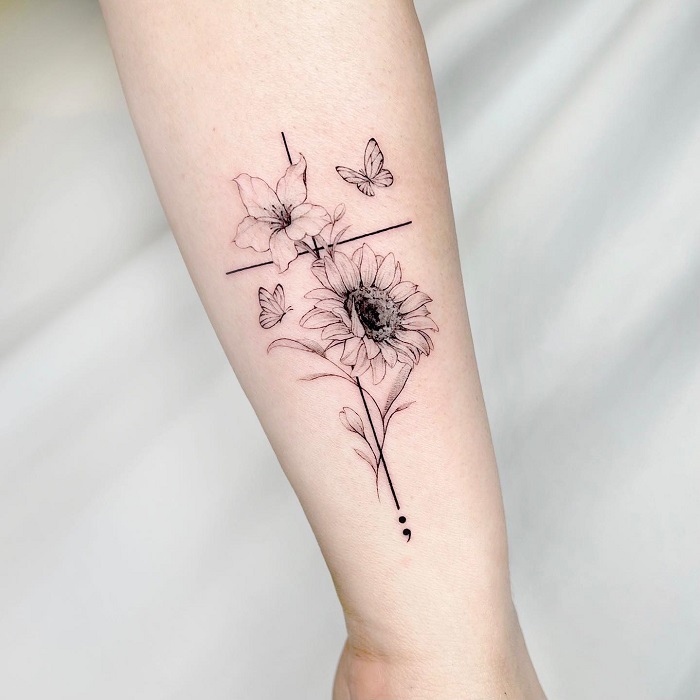
Mixing different floral shapes can make a fine-line tattoo far more dynamic. Here, a lily sits above a detailed sunflower, with two small butterflies occupying the open spaces around them. Thin intersecting lines and a tiny semicolon introduce graphic elements among the organic forms. The varied motifs create interest while the consistent black linework keeps the entire forearm piece visually connected.
18. Flowing Lily Across the Collarbone

This collarbone lily makes movement the main feature. Fine, sweeping lines extend from the flower across the shoulder, echoing the curve of the collarbone and giving the tattoo a windswept, almost hand-drawn quality. Rather than filling the area with extra blossoms, the composition uses negative space and elongated strokes to create scale, making one flower feel substantially more expansive.
19. Shaded Black-and-Grey Lily Branch
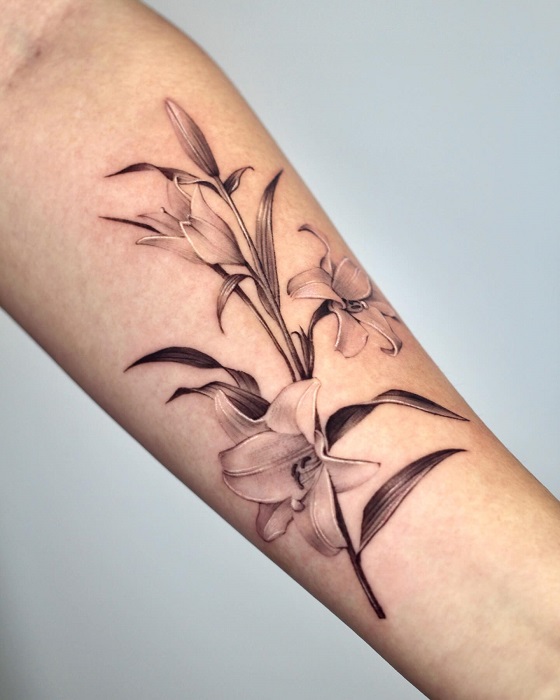
Deeper shading gives this lily tattoo a more sculptural appearance, especially where the dark leaves frame the lighter petals. Multiple flowers and a closed bud follow the same diagonal stem, creating a natural sense of progression along the arm. The limited black-and-grey palette also puts texture in the foreground, from the softly modeled petals to the sharper, elongated foliage.
20. Fine-Line Lily Shoulder Tattoo

Fine-line work brings a light, graceful quality to a lily tattoo, making the flower’s curved petals and slender botanical details stand out without heavy shading. On the shoulder, the composition can follow the body’s natural contours and extend toward the collarbone or upper arm. This style works especially well when negative space is used to keep the floral artwork airy and refined.
21. Fine-Line Lily Ankle Tattoo

The ankle and lower leg suit botanical designs especially well because a stem can follow their narrow vertical proportions. In this piece, wispy leaves extend above a finely drawn lily while a hair-thin stem trails toward the ankle. The restrained black linework keeps the larger flower feeling light, making scale possible without giving the tattoo a heavy appearance.
22. Abstract Watercolor Lily on the Upper Arm
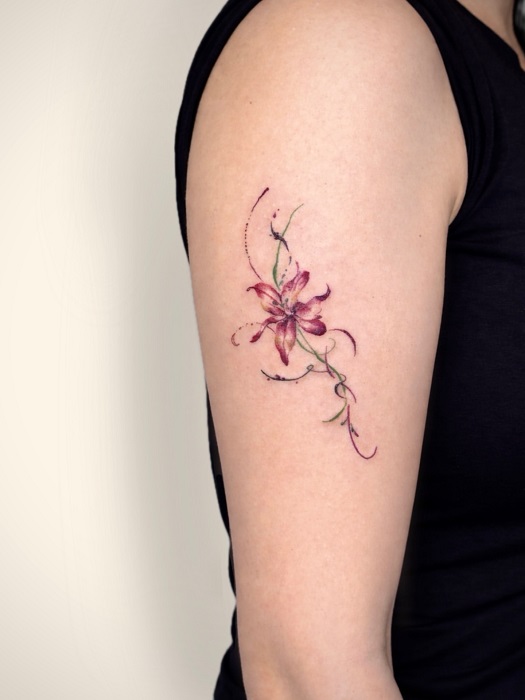
Loose curves and splashes of pink, purple, and green give this upper-arm lily an expressive, almost painted quality. Rather than emphasizing botanical precision, the surrounding strokes create movement around the central bloom and make the edges feel intentionally fluid. It is an interesting alternative to traditional floral realism, especially for readers who prefer lilies interpreted through color and gesture.
23. Small Orange Lily Leg Tattoo

Bright orange petals make this small lily easy to notice despite its compact size. A single unopened bud, a few green leaves, and slender stems provide just enough supporting detail to create a complete botanical composition. Positioned above the ankle, it also demonstrates how saturated color can give a petite tattoo greater visual presence without increasing its overall dimensions.
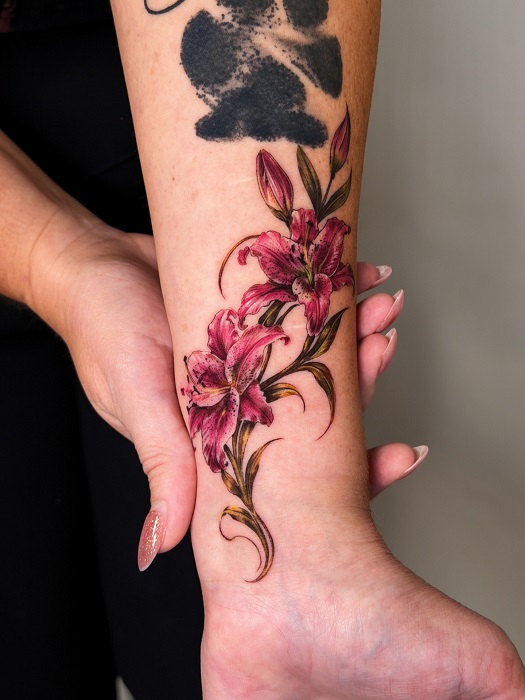
24. Vivid Pink Lilies Around the Wrist
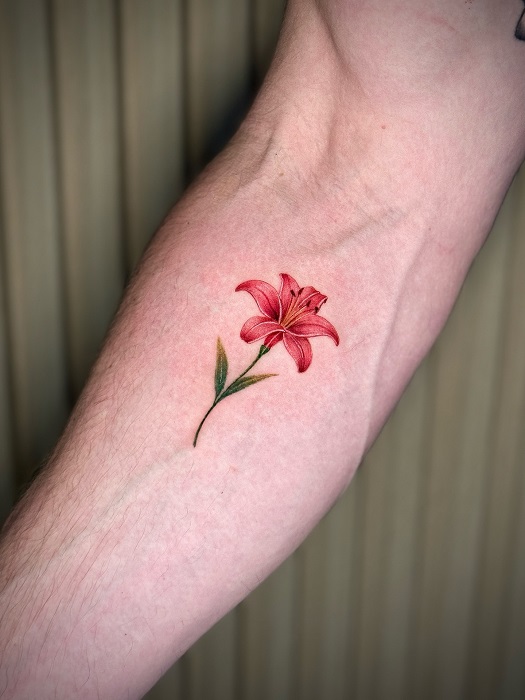
Rather than stopping neatly above the wrist, this floral arrangement follows the arm downward with curling leaves and stems that complement the joint’s shape. Deep pink lilies and unopened buds provide strong color, while darker botanical shading adds depth between the blossoms. The flowing composition is especially useful inspiration for turning a forearm flower tattoo into a more integrated wrist-area piece.
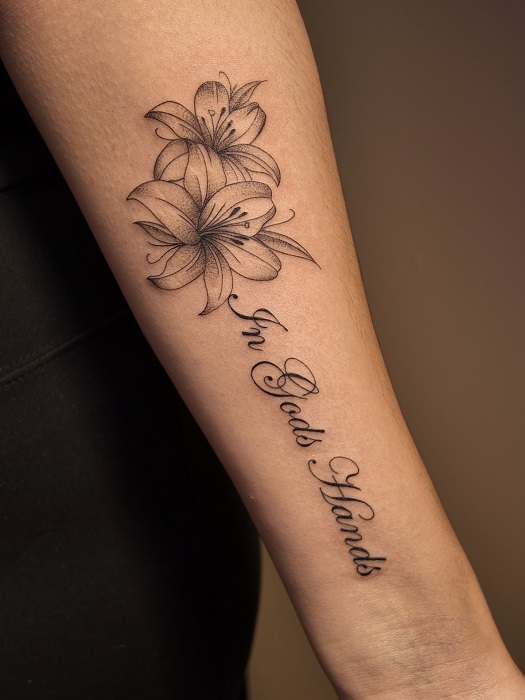
25. Lilies With Elegant Script Lettering
Two softly shaded lilies transition directly into a flowing script inscription, making the lettering feel like part of the composition instead of an addition beneath it. Fine black-and-grey work keeps both elements visually consistent. Names, short phrases, or other meaningful words can be incorporated similarly, although the significance of the visible lettering here is personal and cannot be determined from the image alone.
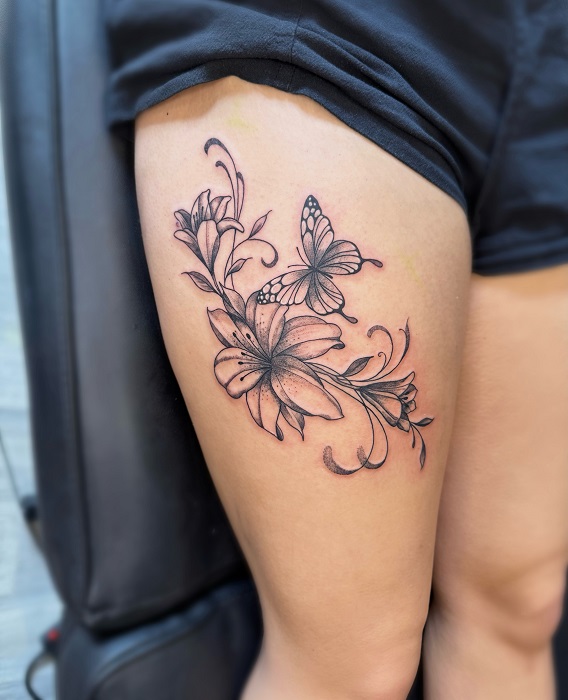
26. Lily and Butterfly Thigh Tattoo
A broad lily anchors this thigh tattoo while a butterfly and additional blossoms spread the composition outward. Curled stems fill otherwise empty areas without requiring dense shading, helping the piece retain an open, illustrative quality. The thigh offers enough room for details such as patterned wings and petal markings to remain readable, making it well suited to larger botanical arrangements.
27. Personalized Pink Lily Forearm Tattoo

Bold lettering runs through the center of this colorful floral piece, framed by pink lilies, dark green foliage, and small hummingbirds. Instead of placing a name separately below the flowers, the composition makes the word itself a major visual element. This layered approach is useful inspiration for a commemorative or personalized tattoo where typography deserves as much attention as the botanical imagery.
28. Orange Lily With a Long Botanical Stem
A single open orange lily dominates this upper-arm piece, with speckled petals and visible stamens providing much of its botanical detail. The long green stem, alternating leaves, and closed bud balance the larger flower while preserving plenty of negative space. Compared with a clustered bouquet, this format emphasizes the recognizable silhouette of the entire plant from bloom to stem.
29. Pink Lily With a Long Text Stem
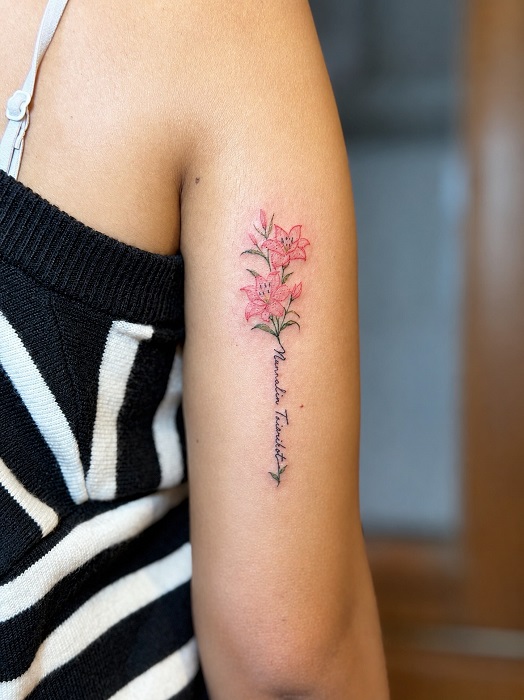
A pink lily paired with elongated lettering turns the stem into an opportunity for personalization rather than treating text as a separate element. The vertical arrangement can give the flower extra length while keeping the overall tattoo narrow and balanced. Names, dates, or short phrases could work in this format, with delicate script helping the transition from petals to typography feel natural.
30. Black-Pink Lily Flower on Upper Shoulder

Combining black detailing with soft pink accents gives this lily tattoo a balance of definition and color without making the palette overly busy. The upper shoulder provides a rounded canvas that suits the flower’s spreading petals, allowing the bloom to become the focal point. Darker outlines or shading can also create contrast that makes subtle pink sections appear more pronounced.
31. Pink-Green Lily With Leaves

Soft pink petals paired with fresh green foliage give this lily tattoo a classic botanical color palette. The leaves help frame the bloom while adding shape and contrast, so the flower does not need heavy outlines to remain visually distinct. This color combination can suit both compact designs and longer floral arrangements, especially when subtle shading is used to create depth.
32. Lily With Long Green Stems

Long green stems give a lily tattoo an elongated, botanical silhouette while creating a natural connection between the bloom and surrounding leaves. Their gentle curves can introduce movement and help the composition flow along the arm or leg rather than appearing compact. Keeping the stems relatively slim also allows the lily itself to remain the strongest visual feature.
33. Orange Lily With a Botanical Stem & Leaves
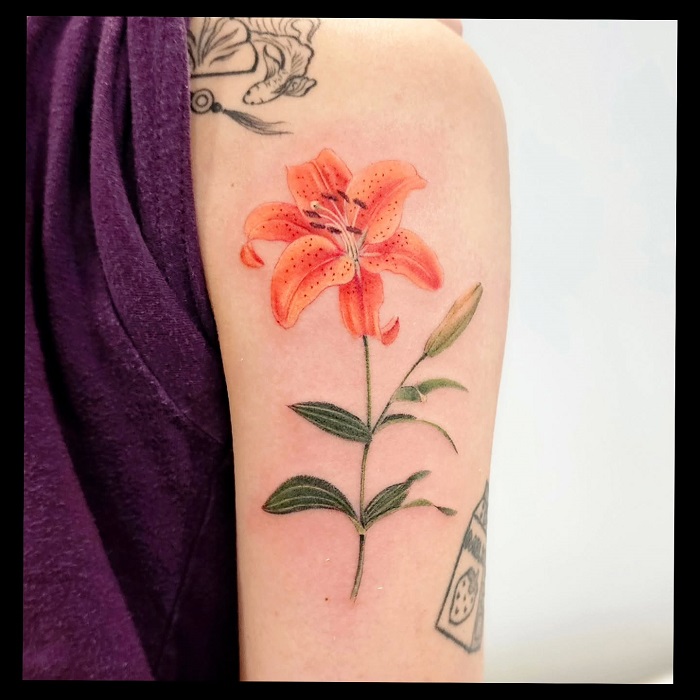
Warm orange petals give the lily an eye-catching focal point, while the extended stem and surrounding leaves bring a more natural botanical structure to the composition. Including foliage also creates useful contrast between the vivid flower and cooler greenery. This approach works particularly well for elongated placements, where the stem can guide the eye along the arm or leg.
Other Blog Posts